Kildare Beginnings
By 1907 it seemed camogie was yet to have an impact amongst women in Kildare. In November 1907 the Leinster Leaders GAA columnist observed that “in the whole county there is not even one colleen’s hurling club.”
Two years later in 1909, progress was noted as Athy Ladies Hurling Club advertised a reunion on 25th July. Miss Campbell was listed as the club captain and Miss Tierney as secretary.
By June 1921, Newbridge, Naas, Blacktrench, Prosperous and Ballymore applied to the County Board for affiliation but it was to be thirteen years later before the Kildare Camogie Board was organised. Nationally, at this stage many clubs had emerged, some playing under camogie rules and some under hurling rules. By 1932 Kildare delegates were attending a full camogie congress in Dublin and all counties containing more than three affiliated clubs were asked to form a county board and to affiliate to Central Council. At this stage there was 75 clubs in Dublin.
In 1934 the Kildare Camogie Board was formed. This seems to reflect the expansion of the game into rural areas in the 1930’s. The early decades of Cumann Camogaiochta na nGael was characterized by the growth of the game predominantly in urban communities. It is unclear why the early 1930’s witnessed such growth in the playing of camogie. It has been suggested that the inclusion of a camogie competition in the 3rd Tailteann in 1932 may have sparked such developments. The Tailteann Games competition led to the establishment of the first All Ireland camogie championship in 1932.
In 1939 Kildare qualified for the Leinster Camogie Final when they were beaten 3-2 to 2-2 by Dublin in Kill. During the Second World War, sporting priorities were second to national economic survival and the maintenance of political neutrality. Living standards were affected; food was rationed and transport was at a standstill. In this unfavourable climate, camogie generally disbanded or was precarious in the county, though some continued to field.
Fifteen years or so on, fortunes had changed somewhat and camogie has been played on Kildare’s green fields. Notably, in 1980 Kildare reached the final of the first ever Junior National League. Armagh won the first junior League title by scoring late against Kildare at the game played in Cappagh.
From navy to brown to Lilywhite
Although today, known and playing as the Lilywhites, this was not always the case. Records and memories say that Kildare previously played in navy and white (during the 1930s); brown and white (1955+) and blue and white (1965).
The May 1955 County Board meeting decided to adopt the brown and white, the Properous colours, as the county colours.
In April 1963, the County Board decided that the county team should have uniforms of its own. The Board was in good financial position and this allowed for the purchase of camogie uniforms. White was decided as the colour of the uniform. However, the following April 1964, the Board decided that some colour other than a white blouse would have to be worn as the white gym and blouse did not look well together. The Board decided that if possible they would get blue blouses. In 1965 the blue blouses of Naas were worn in the Leinster Championship.
From gymslips to skirts to skorts
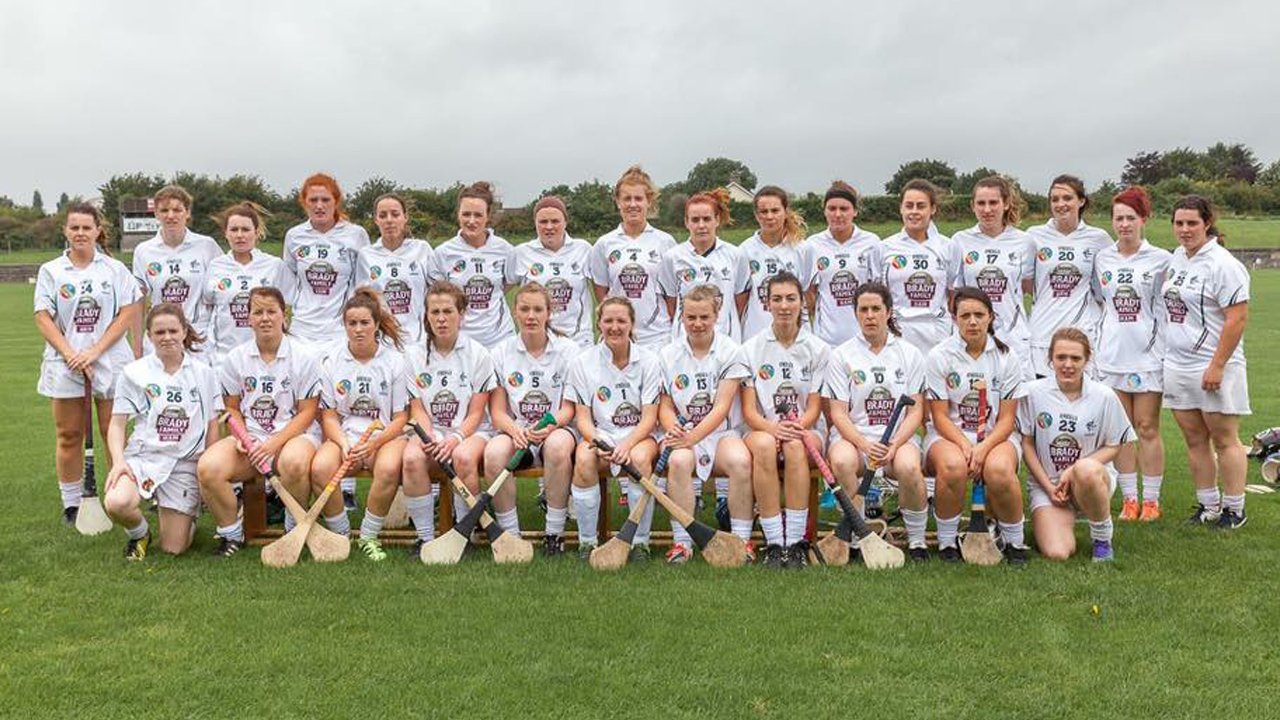
A motion from Prosperous, seconded by Cappagh, to the 1979 Annual Convention got agreement to change the county team uniform. It was agreed to change from a gymslip to a white wrap around skirt with blue shirt (jersey) and blue knee socks (under 16) teams were the first to wear this new team kit. By 1983 the lilywhites (all white) uniform was adopted.
In 2004 in recognition of the achievement of reaching the National League Junior final, Kildare county camogie board agreed to replace the wrap skirt with the new style skorts for the county junior team. Each county junior player received a personal skort. Skorts are light wearing integrated skirt/shorts similar to culottes.
Extracts from the book “Soaring Sliothar – A centenary of Kildare Camogie 1904 – 2004” by Joan O’Flynn.